
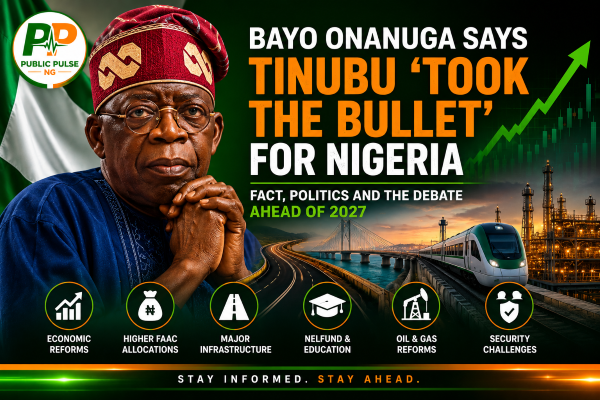
Tinubu Took The Bullet: Onanuga’s Case for Tinubu’s Economic Reforms
The Special Adviser to President Bola Tinubu on Information and Strategy, Bayo Onanuga, has published a lengthy defence of the Tinubu administration, describing the President as “the man who took the bullet for Nigeria to survive.”
The article is one of the clearest political and economic justifications yet offered by the Presidency as Nigeria gradually moves toward the 2027 general election.
What Is Onanuga’s Main Argument?
According to Onanuga, President Tinubu inherited a fragile economy in May 2023, characterised by fuel subsidy costs, multiple exchange rates, revenue challenges and growing fiscal pressures.
He argues that the administration deliberately implemented difficult reforms, including subsidy removal and exchange-rate reforms, despite the political risks involved.
In his view, the short-term pain was necessary to prevent a deeper economic crisis.
Key Achievements Highlighted
Onanuga cited several areas where he believes the administration has recorded progress:
- Increased FAAC allocations to states.
- Major road infrastructure projects, including the Lagos-Calabar Coastal Highway and Sokoto-Badagry Highway.
- Expansion of rail development plans.
- Growth in stock market capitalisation.
- Student support through NELFUND.
- Consumer credit initiatives through CREDICORP.
- Reforms in the oil and gas sector.
- Efforts to stabilise the electricity sector.
He also argued that many governors have publicly acknowledged the benefits of increased federal allocations following subsidy removal.
Where Critics Disagree
While many of the projects and programmes referenced by Onanuga are verifiable government initiatives, critics argue that economic success should not be measured only through infrastructure spending, stock market performance or government revenue.
Opposition figures and many citizens continue to focus on:
- Inflation levels.
- Food prices.
- Cost of living pressures.
- Purchasing power.
- Security concerns.
- Youth unemployment.
For many Nigerians, the central question remains whether the benefits of the reforms are being felt in everyday life.
The Bigger Political Message
Beyond defending government policies, the article appears to outline what could become a major APC campaign argument ahead of 2027:
“The reforms were painful, but necessary.”
The Presidency’s position is that difficult decisions were required to prevent long-term economic decline.
Critics counter that citizens should judge reforms by their real-life impact rather than official statistics.
The debate around Tinubu’s reforms is unfolding alongside other major political and electoral developments ahead of 2027. Recent controversies involving party primaries and court rulings on INEC’s powers have also raised questions about the future direction of Nigeria’s democracy. Readers may also find our analysis of the APC Primary Figures and the 2027 Debate and the INEC vs Youth Party Court Battle useful for additional context.
Public Pulse NG Analysis
The significance of Onanuga’s article lies not only in the achievements it highlights but in the political narrative it seeks to establish.
The article acknowledges that the early years of the reforms were painful, while arguing that the gains are now beginning to emerge.
As Nigeria approaches 2027, the debate may no longer centre on whether the reforms happened.
Instead, it may focus on a more important question:
Have the benefits become visible enough in the lives of ordinary Nigerians to justify the sacrifices that were made?
That question is likely to shape much of Nigeria’s political conversation over the next two years.