
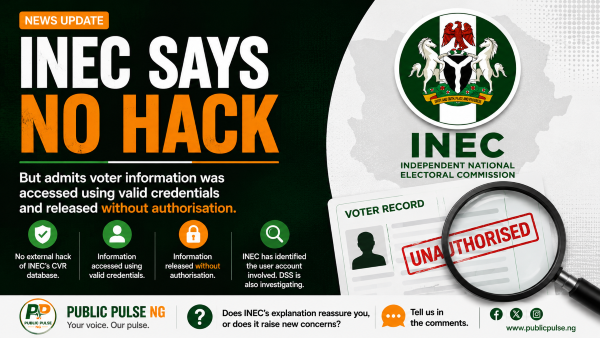
The INEC voter information release controversy has taken a new turn after the Independent National Electoral Commission (INEC) said there was no external hack of its database. However, the Commission confirmed that voter information was accessed using valid credentials and later released without authorisation.
The statement follows public debate over voter information linked to an NDC House of Representatives aspirant.
INEC said its preliminary findings show that no outsider gained unauthorised access to its Continuous Voter Registration (CVR) database. According to the Commission, the information was retrieved through credentials assigned to authorised personnel involved in the voter registration process.
The Commission added that it has already identified the user account involved and questioned relevant personnel as part of an ongoing investigation.
What INEC Said About the Voter Information Release
INEC stated that Registration Officers participating in the ongoing CVR exercise are granted controlled access to specific parts of the system to perform official duties.
According to the Commission, there was no breach of its wider ICT infrastructure and no compromise of the personal records of over 90 million registered voters.
However, INEC acknowledged that information was accessed through valid credentials and later disclosed without approval.
The Commission said it is working with security agencies, including the Department of State Services (DSS), to determine how the information was released and who was responsible.
Why the INEC Voter Information Release Matters
The controversy has shifted the conversation from hacking to accountability.
While INEC insists there was no external breach, many Nigerians are asking how information obtained through authorised access found its way into the public domain.
For ordinary citizens, trust in electoral institutions depends not only on protection against hackers but also on strong internal safeguards.
The INEC voter information release has therefore raised questions about staff oversight, data protection and accountability within the electoral system.
Public Pulse NG Analysis: The Bigger Question
INEC deserves credit for responding quickly and clarifying that there was no external hack of its database.
However, the key public-interest question remains unanswered.
If voter information can be accessed through authorised channels and later released without approval, what safeguards failed and what changes will be introduced to prevent a repeat?
For many Nigerians, the issue is no longer about cyberattacks. It is about confidence in the systems designed to protect sensitive voter information.
The outcome of the investigation may be just as important as the incident itself.
Questions Nigerians Are Asking About the INEC Voter Information Release
- Who accessed the information?
- Was any law or regulation violated?
- What disciplinary action will follow?
- What safeguards will prevent a similar incident in the future?
As investigations continue, Nigerians will be watching closely for answers.
What Do You Think?
Does INEC’s explanation reassure you, or does it raise fresh concerns about voter data protection and internal controls?
Share your views in the comments.